In partnership with

The Future of Tech. One Daily News Briefing.

AI is moving faster than any other technology cycle in history. New models. New tools. New claims. New noise.
Most people feel like they’re behind. But the people that don’t, aren’t smarter. They’re just better informed.
Forward Future is a daily news briefing for people who want clarity, not hype. In one concise newsletter each day, you’ll get the most important AI and tech developments, learn why they matter, and what they signal about what’s coming next.
We cover real product launches, model updates, policy shifts, and industry moves shaping how AI actually gets built, adopted, and regulated. Written for operators, builders, leaders, and anyone who wants to sound sharp when AI comes up in the meeting.
It takes about five minutes to read, but the edge lasts all day.
March 30
TODAY IN BASEBALL HISTORY
Hey Folks!
March 30 is the day two of the greatest pitchers who ever lived decided enough was enough. When Sandy Koufax and Don Drysdale walked into the Dodgers' offices together in 1966 and said they wouldn't pitch until they were paid fairly they changed the economics of baseball forever. Their 32-day joint holdout was considered outrageous at the time — players simply didn't do that. But the seed they planted that spring eventually grew into something the owners misread and cost them billions. Today we also look back at Murry Dickson's forgotten gem — a nine-inning no-hitter against the Yankees in spring training in 1948, the first of its kind in baseball history. Marvin Miller stands on the eve of the first strike in baseball history on this date in 1972, telling 663 players ready to walk that it's all up to them now. A young Dennis Eckersley arrives in Boston in 1978. And Enron Field opens its doors in Houston in 2000 — a beautiful ballpark that has a checked history and is remembered for all the wrong reasons. March 30 gave us holdouts, history and one very complicated corporate name.
Player of the Day: The Eck
March 30, 1978 Boston Red Sox acquire pitcher Dennis Eckersley and catcher Fred Kendall from the Cleveland Indians. He will win 20 games and was the team's ace, although the task of pitching the decisive one-game playoff against the New York Yankees on October 2nd fell to his teammate Mike Torrez, since Eckersley had earned a key win in a start 48 hours earlier. He remained a mainstay in the Boston rotation until 1984, getting the start in the 1982 All-Star Game.
After an early career as a brash young flamethrower and a seven-year spell as a mediocre starter, The Eck was reborn in Oakland as a dominating bullpen stopper. In the process, he became the only player in major league history to record 100 complete games and 200 saves.
Eckersley broke into the majors with the Cleveland Indians in 1975 as a somewhat brash young pitcher with longish hair and 90+ mile-per-hour fastball. It was a promising, if not wholly satisfying campaign. Maintaining a 2.60 ERA with a 13-7 won-loss record, Eck was named AL Rookie Pitcher of the Year. Over the next two seasons the offbeat wiseguy averaged 14 wins and 196 strikeouts.
On May 30, 1977 he pitched a devastating 12-strikeout no-hitter against the California Angels. True to form, Eckersley traded barbs with opposing hurler Frank Tanana throughout the game, and when the Angels' Gil Flores came to bat with two outs in the ninth, Eckersley continued to rant. "I was ready, but Gil kept on stepping out of the [batter's box]," Eckersley later told the Contra Costa Times. "I pointed at him, 'Get in there. They're not here to take your picture. You're the last out. Get in there.' I was pretty cocky back then."
In 1978 Eckersley was traded to Boston in a deal that brought Bo Diaz and Rick Wise to Cleveland. In his first year with the Red Sox, he enjoyed his best season as a starter with a 20-8 record and a 2.99 ERA. Eckersley was particularly stunning down the stretch, winning his last four starts with complete games, including a crucial three-hitter vs. New York in late September, as the Red Sox attempted to stave off the Yankees’ challenge for the AL East crown. Despite Eckersley's best efforts, the teams ended the regular season in a tie, and the Yankees went on to win the division in an intense one-game playoff at Fenway Park.
He won 17 games the following year, but after that his numbers began to sag. After four mediocre seasons in Boston (including a poor 9-13, 5.61 ERA tour in '83), Eckersley was traded to the Chicago Cubs for Bill Buckner early in the 1984 season. Being traded from one seemingly cursed loser (the Red Sox haven't won a World Series since 1918) to another (the Cubs' last trophy was circa 1908) seemed to invigorate Eckersley. His ERA improved dramatically from 5.01 to 3.03, helping the Cubs make the playoffs for the first time since 1945. Eckersley started Game Three of the 1984 NLCS with the Cubs needing only one victory in three games to reach the World Series. He faltered early and gave up five runs in 5.1 innings as Chicago went on to lose Game Three, and eventually the series, to the San Diego Padres.
The following two seasons saw Eckersley's fastball lose velocity and his personal life take a nosedive as he struggled with alcohol abuse.
In 1987 Eckersley was traded to Oakland, where A’s manager Tony LaRussa planned to use him as a set-up man/long reliever. Yet after an injury to Jay Howell, Eckersley got the closer’s job. His performance surprised everyone. After the All-Star break, Eckersley recorded 13 saves and struck out 51 batters -- with just five walks -- in just 43.2 innings pitched. Abandoning his wild, fireballing style, pinpoint control became the signature of the new Eck.
The following year was a renaissance for the entire A's ballclub. Eckersley's cool and efficient confidence which defined the team. His shaggy long hair and trimmed mustache, combined with his 45 saves (one short of the ML record) and 70 strikeouts evoked memories of the flamboyant arrogance of Oakland's three-time world champions of the early seventies. Unfortunately, the team that lived by Eck, died by Eck. After Eckersley gave up a ninth-inning, pinch-hit two-run homer to Kirk Gibson to end Game One of the 1988 World Series, the A's collapsed to the seemingly out-manned Dodgers, losing the series in five games.
Eckersley dominated the American League for the next five years. In 1989 he saved 33 games with a 1.56 ERA, giving up only three walks against 55 strikeouts. He also won his first World Series, recording the final out of the A's four-game sweep of the San Francisco Giants. Energized by the championship, Eckersley followed with his best season to date. In 73.1 innings pitched, Eckersley allowed exactly five earned runs (a 0.61 ERA) en route to saving 48 games. Perhaps more phenomenally, he managed to strike out 73 batters while walking only four.
His 1992 campaign. Eck started off the season with a major-league record 36 consecutive saves. By the end of the year, he had tallied 51. Even more impressive, he only walked 11 batters -- six intentionally -- while striking out 93. With his last save of the season, Eckersley broke Dan Quisenberry’s AL record of 239.
Eckersley never regained the magic he captured in ’92. In each of his next three seasons he failed to bring his ERA below four and after a disappointing 1995 season was traded to the Cardinals for Steve Montgomery. In St. Louis, he was reunited with ex-Oakland manager La Russa. Despite nagging injuries and a 42-year-old body, Eckersley returned to his old form, saving 30 games and walking only six batters in 60 innings pitched. During the Cardinals’ post-season run, Eckersley recorded four saves without allowing a run and did not appear in a Cardinals loss.
After another 30+ save year for St. Louis in 1997, Eck signed with the Boston Red Sox. He failed to beat out Tom Gordon for the closer’s job in spring training and spent a large part of the first half on the DL. After recording just one save in fifty innings of work Eckersley finally called it quits.
More on Eck!

Here are links to check out!
Check out his SABR Bioproject here written by Bill Nowlin - David Southwick
His Baseball Reference Page for Eck here all the stats you will ever need
Visit him in Cooperstown
Dennis Eckersley (as told to George Vass): "The Game I'll Never Forget", Baseball Digest, February 1992, pp. 79-81.
Martín Gallegos: "Top 10 highlights of Dennis Eckersley's career", mlb.com, February 27, 2022.
Douglas Jordan: "The Last Thousand-Hundred Man", in Baseball Research Journal, SABR, Vol. 49, Nr. 1 (Spring 2020), pp. 69-72.
Mike Lupica: "He should be known for more than HR he gave up: 'I can live with it. I'm in the Hall of Fame. I'm cool.'", mlb.com, June 3, 2020.
Rick Sorci: "Baseball Profile: Pitcher Dennis Eckersley", Baseball Digest, July 1992, p. 65.
Strapped for time? We also have a daily podcast you can take with you!

Quote of the day:
Eck coined the term "walk-off home run", using it in a postgame interview after Kirk Gibson took him deep in the '88 World Series.
Mike Lupica: "He should be known for more than HR he gave up: 'I can live with it. I'm in the Hall of Fame. I'm cool.'"
Game of The Day:
Game of the Day — What else! May 30, 1977 Cleveland Indians vs California Angels
Eck fires a gem!

March 30 highlights and Historic Days!
March 30, 1948, Murry Dickson of the St. Louis Cardinals achieves a rarity: a spring training no-hitter. Dickson shackles the New York Yankees, becoming the first pitcher to throw a nine-inning no-hitter in spring training. Prior to Dickson, two no-hitters had taken place in the spring, but both were shared by more than one pitcher.
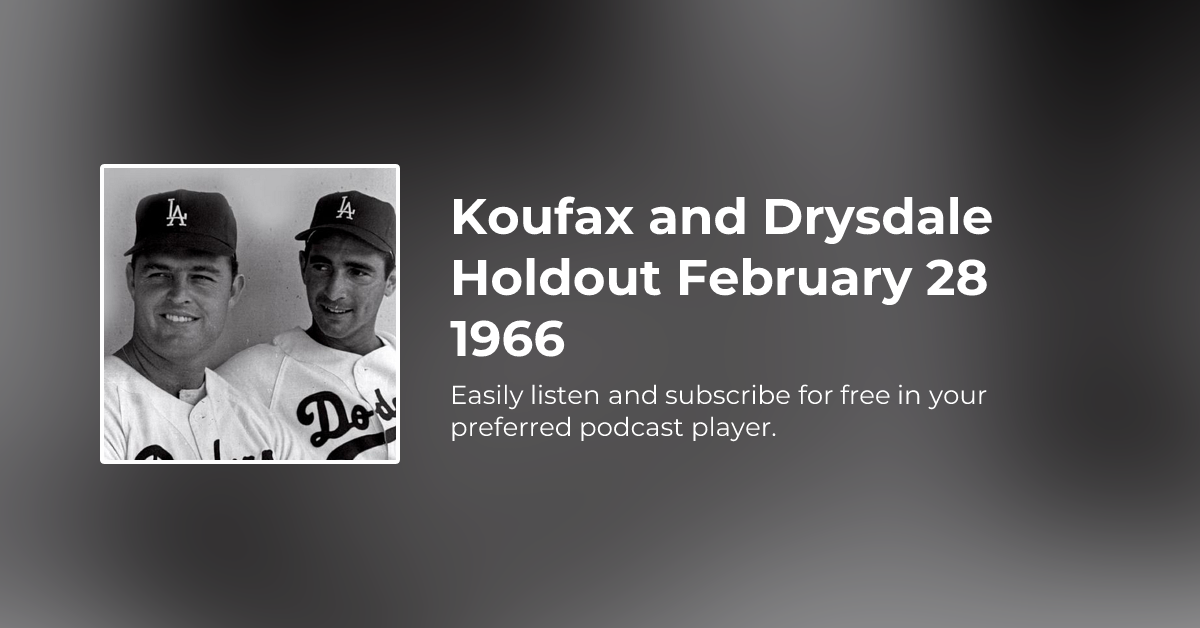
March 30, 1966 — Sandy Koufax and Don Drysdale’s refusal to report to spring training ends when the hurlers agree to the Dodgers’ offer of $235,000, signing for $130,000 and $105,000, respectively. The LA starters’ joint holdout lasts for 32 days, threatening retirement in an effort to acquire pay raises. The pair had begun movie and TV show production during the hiatus.
This move ultimately paved the way paving for other players to be more aggressive when negotiating with owners. The owners also hurt themselves by adding collusion verabage in the next CBA which has cost them dearly.
March 30, 1972 — – Marvin Miller executive director of the Major League Baseball Players Association Thursday said on the eve of a critical vote on whether to call a strike against the game “It’s all up to the players now” Miller concluded his poll taking among the 34 big league clubs Thursday with the Milwaukee Brewers The final count. Shows 663 players in favor of calling a strike unless their demands for an improved pension are met and only 10 were against with two abstentions “Obviously we have an overwhelming sentiment for a strike” Miller said “Now it’s up to the players and they have the right to do what they think best.”
March 30, 1981 Chicago White Sox purchase Greg Luzinski from the Philadelphia Phillies. Luzinski returned to his hometown when his contract was sold to the Chicago White Sox. As the team's designated hitter, he hit 21 home runs in his first year with the club, one less than the American League-leading total of 22, shared by four players. The following summer, 1982, he hit .292 with 18 home runs and 102 RBI. He was a team leader on the division-winning White Sox in 1983, clubbing 32 homers, 3 of which cleared the Comiskey Park roof.
March 30, 1991 A sold-out Joe Robbie Stadium plays host to the Yankees and the Orioles exhibition game, which draws 67,654 fans, a spring training attendance record
March 30 , 2000 — Enron Field officially opens with a 6-5 exhibition win over the A.L. Champion New York Yankees, paralleling the feat that occurred when the Astrodome opened in 1965. Daryle Ward’s two-run homer caps a four-run eighth-inning rally to open up the Astros’ new home in style.
The Voices That Defined Baseball Are Waiting for You to listen to this game: Members click here or Start your free 7-day trial
TRIVIA
TRIVIA: Eck saved 390 games, 57 of them were for one pitcher, the two had the all time record until Mo Rivera and Andy Pettitte topped it. Who was it?
IF you think you know the answer and bonus points for how many respond with details and if you are right I will give you a shut out! No Googling!
Answer in tomorrows newsletter
New From Around the League!
Know someone who loves baseball like you do? Earn rewards by sharing the Rewind!
ANSWER TO YESTERDAY’S TRIVIA
YESTERDAY'S TRIVIA: What pitcher has the most consecutive hitless innings?
Answer: Cy Young as mentioned in yesterdays Newsletter
JOIN CLASSIC BASEBALL BROADCASTS TODAY
"Every story in today's newsletter has a broadcast behind it. They're all in the archive, exactly as they sounded on the radio the day they happened. Start your free 7-day trial and hear them tonight."
Get the FREE 7 day trial!
Press Play On Baseball History
Free subscribers read about baseball history. Paid subscribers hear it. Upgrade and unlock the Game of the Day broadcast plus select audio from our archive of 10,000+ hours of original radio broadcasts — legendary voices, real crowd noise, and moments that sound even better than they read. Less than a cup of coffee a month. Cancel anytime.
UpgradeDaily Full Game Broadcasts:
- Daily Full Game Broadcasts
- Periodical Interviews
