In partnership with

Smart starts here.

You don't have to read everything — just the right thing. 1440's daily newsletter distills the day's biggest stories from 100+ sources into one quick, 5-minute read. It's the fastest way to stay sharp, sound informed, and actually understand what's happening in the world. Join 4.5 million readers who start their day the smart way.
March 20
TODAY IN BASEBALL HISTORY
On March 20 2012, the Boston Red Sox winningest left-handed pitcher, not Jon Lester, Babe Ruth, or Lefty Grove, Mel Parnell passed away. His 123 wins rank 4th all time behind Tim Wakefield (186), Cy Young (192), and Roger Clemens (192).
Read about Mel and the Pesky Pole below!
Pesky's Pole stands just 302 feet from home plate (this number is disputed — the actual distance may be closer to 295 feet). Personally, I have signed it, took pictures next to it, and was sitting maybe 60 feet away from it when, according to Ian Browne, the most famous homerun was ever hit off it, Mark Bellhorn's homerun in the bottom of the 8th in game one of the 2004 World Series. I can still hear the sound it made.
Mel Parnell has been credited with naming the pole after Pesky helped him win a game with a late homerun around the pole, but that never happened. In a career that spanned 1,270 games (1,029 for Boston), Pesky hit just 17 homers. In 539 games at Fenway, the left-handed-hitting Pesky hit all of six home runs. Pesky hit only one home run during his career in a Parnell start, and it was early against Detroit in a game he lost, so how the name came about is a mystery.
Despite thousands of references, the Red Sox took their time and officially dedicated "Pesky's Pole" on September 27, 2006, on Johnny Pesky's 87th birthday. Two years later, they retired his No. 6 to the façade at Fenway Park in right field.
It is fitting that a piece of Fenway Park is named after Pesky, who was one of the great ambassadors in Red Sox history, serving in pretty much every role possible in a 61-year association with the team that lasted until his death at the age of 93 in 2012.
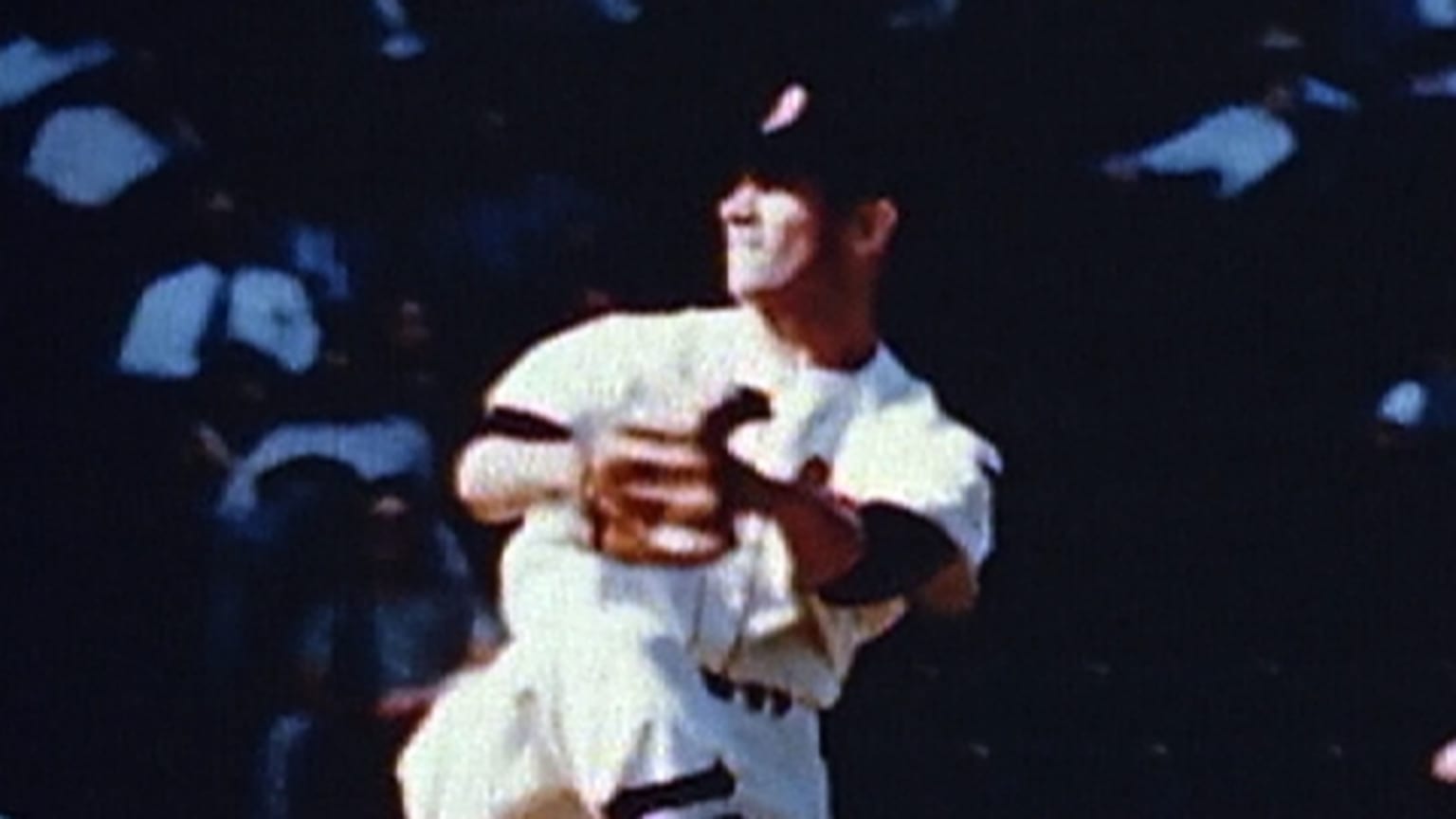
Mel Parnell
On March 20 2012, the Boston Red Sox winningest left-handed pitcher, not Jon Lester, Babe Ruth, or Lefty Grove, Mel Parnell passed away. His 123 wins rank 4th all time behind Tim Wakefield (186), Cy Young (192), and Roger Clemens (192).
If you spend time with the Red Sox All-Time Leaders, Parnell's name doesn't appear in any of the power categories, WHIP, SO per 9, ERA, ERA+; he barely made the top 10 in WAR. He just had a knack for winning. Especially at Fenway, where he went 70-30 over his career. This had to be a testament to his team's offensive prowess; the team scored 6 or more runs in nearly half his starts. His home/road era is nearly identical, 3.39 home and 3.59 road.
Parnell had made his debut as a 25-year-old after spending 3+ years in the military and had a real coming-out party in 1948, going 15-8.
There is one 1948 game he still wishes he'd pitched. He fully expected to start for the Red Sox in the one-game playoff for the pennant on October 4 against the Indians. He's been asked about it so much, he says, that he could write a book about it. "The whole ball club thought it was my game. I got to the ballpark the next morning, and McCarthy came up from behind and put his hands on my shoulders. He says, 'Kid, I've changed my mind. I'm going with the righthander instead of the lefthander today because of the elements.' The wind was blowing out. [Denny] Galehouse comes in, McCarthy tells him he's the pitcher, and his facial expression changes completely. It was a shock to him."
Galehouse got through the first three innings well enough, but imploded in the fourth, and the Red Sox managed only five hits, losing 8-3.
His 1949 campaign is one of the best in team history for a lefty, setting the club season mark for a lefty with 25 wins, leading the league in wins, ERA, innings pitched, and complete games. The season came down to the wire, and this time he did pitch a possible pennant clincher in the second-to-last game of the year, but got chashed by the Yankees after 4. The Red Sox again came up a game short of the pennant.
Mel will win 20 games once more in 1953, and he pitched a no-hitter on July 14, 1956, against the Chicago White Sox. For the last out of his no-hitter, Parnell got pinch-hitter Walt Dropo to bounce a groundball back to the mound. Parnell ran the ball to first base himself to record the putout. He said he was afraid Walt would drop the ball.
How it ended:
His career will come to an end after the 1956 season with an elbow operation to try to fix a torn nerve. He figures today that if the Tommy John surgery had been available to him at that time, he might have had as much as another four or five years in his career, but it was not to be.
He could swing the lumber -
Parnell hit over 300 twice in over 80 at-bats and hit .254 in 1949 in 124 at-bats. "I had two .300 years. One year, I was a little higher than [Ted] Williams, and I always used to kid him, "Well, Bush, I out-hit you."
After his career, he ended up in the broadcast booth, and in 1967, he called the final out of the last regular-season game of the "Impossible Dream" season for the 1967 Red Sox on WHDH-TV.
"Little soft pop-up...Petrocelli will take it...he does! The ball game is over! The Red Sox win it! And what a mob on this field! They're coming out of the stands from all over!"
Mel Parnell Highlight Reel
Tell us who your favorite team is and we will send you custom content!
Top 10 games for each franchise, every three homerun game, best players, and much more!
More on Mel:

Here are links for the pair!
Check out his SABR Bioproject here written by Bill Nowlin (quoted in this article)
Ian Brown of Pesky Pole history
His Baseball Reference Page for Mel here all the stats you will ever need
Visit him at Fenway Park at the Red Sox Hall of Fame
If you are interested in Collecting his memorabilia check out Sports Memorabilia.com
Mel Parnell interview with Harvey Frommer
Mel is mentioned in Terry Cashman’s: Talkin Baseball (The Thumper and Mel Parnell)
Quote of the day:
Parnell no hitter in 1956 was the first by a Red Sox pitcher in 33 years. “This is something a pitcher dreams of,” Parnell told The Times-Picayune in 2002. “You never expect it to happen.”
Game of The Day:
Game of the Day — October 1, 1967 Minnesota Twins vs Boston Red Sox
As noted above Mel is on the mic with Curt Gowdy and Ned Martin calling the final game of a thrilling and unexpected 1967 season.

Listen to the Game here.
The Voices That Defined Baseball Are Waiting for You to listen to this game: Members click here or Start your free 7-day trial
Full Membership Preview:
I created a full walk through for you to take a peak at our membership site, Classic Baseball Broadcasts. Here is the link and it has several videos, how tos, what’s in side and a link to the 25 greatest moments you can listen too!
Todays highlights and Historic Days!
Born: March 20, 1871 in Cornwall, IL . . . Joe McGinnity did not get to the majors until he was 28, then lasted only 10 seasons, but earned his sobriquet, Iron Man, by his frequent appearances. He often pitched both halves of doubleheaders. He had had two inauspicious years in the minors, and was pitching semi-pro ball when he developed an underhand delivery and change of pace which, in one season, vaulted him to the majors. As a rookie with the 1899 Baltimore Orioles, he led the National League with 28 victories.
March 20, 1934 -- Mildred Didrickson (also known as Babe Zaharias), the renowned all-around female athlete, pitches the 1st inning for the Philadelphia Athletics in a spring training exhibition game at McCurdy Field in Frederick, Maryland against the Brooklyn Dodgers. She gives up one walk but no hits. Two days later she pitches again, this time one inning for the St. Louis Cardinals against the Boston Red Sox. Didrickson is less successful the second time, giving up four hits and three runs. Bill Hallahan relieves her, as she does not have an at bat in either game. She will also play several games for the House of David this season. Didrickson is the second female to play exhibitions with a major league team. Previously, first baseman Lizzie Murphy played for an American League All-Star team on August 14, 1922.
March 20, 1937, the Homestead Grays of the Negro Leagues acquire future Hall of Famers Josh Gibson and Judy Johnson for $2,500 in cash and a pair of journeymen players. The trade is considered the largest transaction in the history of the Negro Leagues. The Baseball's Hall of Fame will induct both players, with Gibson becoming a member in 1972 and Johnson, following three years later.
March 20, 1953 -- U.S. Senator Edwin C. Johnson offers a bill to give clubs the sole right to ban radio-TV broadcasts of major league games in their own territory. The antitrust division of the Justice Department outlawed this practice in 1949. Johnson believes that it started the decline of baseball in small towns and cities throughout the country. His bill aims to restore the equity between large communities and the small areas.
March 20, 1973 -- Roberto Clemente becomes the first Hispanic American to gain election to the Hall of Fame. The Baseball Writers Association of America announces the results of a special ballot, with Clemente receiving 393 of 424 votes. Clemente died in a plane crash on New Year's Eve. In light of his tragic death, the Hall's Board of Directors waived the five-year waiting period that is normally required before a player is eligible for election. A twelve-time All-Star, Clemente batted .317 and won a dozen Gold Gloves over an 18-year career, and batted .362 in World Series play. Named National League MVP in 1966, he was voted the outstanding player in the 1971 World Series, when the Pittsburgh Pirates beat the heavily-favored Baltimore Orioles in seven games.
March 20, 1975 -- A rare spring training brawl takes place when Ranger second baseman Dave Nelson takes exception to the two brushback pitches thrown at him by Yankee southpaw Mike Wallace in the seventh inning of an exhibition contest at played Fort Lauderdale. The trouble begins brewing early when Jim Bibby’ first pitch of the game plunks the shoulder New York’s leadoff hitter Elliot Maddox, who had deeply angered Texas skipper Billy Martin when he told the local press that his former manager "has a habit of lying to his players."
Died: March 20, 1984 in South Bend, IN Using a fluttering spitball that dove sharply and broke inside on lefties and righties, Stan Coveleski helped two unlikely teams to the World Series. He won three games in the 1920 Series — the first championship for Cleveland, and in 1925 he helped the Senators to the World Series in his first year with that club, winning 20 games. He consistently topped 275 innings pitched and was a valuable pitcher well into his mid-thirties. Coveleski learned the spitter while in the minors in 1913-1915, earning a permanent spot in the big leagues in 1916 when the Indians bought his contract. A longtime resident of South Bend, Indiana, the ballfield in that college town bears his name. He was inducted into the Baseball Hall of Fame in 1969.
March 20, 1989 - Commissioner Peter Ueberroth announces that he has begun an investigation into the behavior of Cincinnati Reds manager Pete Rose.
Every event has an audio story with it — Members click here Not a member? Start your free 7-day trial
TRIVIA
TRIVIA: Mel Parnell won 25 games in 1949, only two other pitchers in team history topped 25 in a single season, who are they? Bonus who tied him with 25?
IF you think you know the answer and bonus points for how many respond with details and if you are right I will give you a shut out! No Googling!
Answer in tomorrows newsletter
Mel Parnell won 25 games in 1949, only two other pitchers in team history topped 25 in a single season, who has the most wins in a single season?
New From Around the League!
Know someone who loves baseball like you do? Earn rewards by sharing the Rewind!
ANSWER TO YESTERDAY’S TRIVIA
YESTERDAY'S TRIVIA: Richie Ashburn is one the best fly catchers in MLB history. He ranks 3rd in career putouts, who are the two centerfielders ahead of him?
Answer: the immortal Willie Mays and Tris Speaker
JOIN CLASSIC BASEBALL BROADCASTS TODAY
"Every story in today's newsletter has a broadcast behind it. They're all in the archive, exactly as they sounded on the radio the day they happened. Start your free 7-day trial and hear them tonight."
Get the FREE 7 day trial!
